The most common question we get from someone about to book a first stay is some version of the same worry: if there is nobody standing at a desk, who is going to help me? It is a fair thing to ask, and the honest answer is easier to give from the arrival backwards than from a list of features forwards.
So here is the arrival. Your code comes before you land. You walk from wherever you parked to your own door and you open it. There is no lobby to cross first, no line, no laminated map, no ten minutes of standing while somebody types. If you get in at 1 a.m. after a delayed flight, none of that changes.
What a front desk mostly does is confirm who you are and hand you a key. Your phone did both of those things before you got here.
A front desk is not the hospitality. It is the queue standing between you and the room you already paid for.
Who is actually there
Removing the desk is only defensible if the help gets better, and this is the part that usually surprises people. Our team is on around the clock, by phone or by text, and they are real people rather than a bot with a script. That is not a downgrade from a clerk in a lobby. It is the opposite.
A desk is help that exists in one place and, at most hotels, only during certain hours. Reach it and you have to be standing in front of it. Text us at 2 a.m. from bed because the heater is being difficult and somebody answers, without you putting shoes on.
What the space becomes
Here is the good part. The moment a lobby is no longer a place where people queue, it can go back to being a place where people sit.
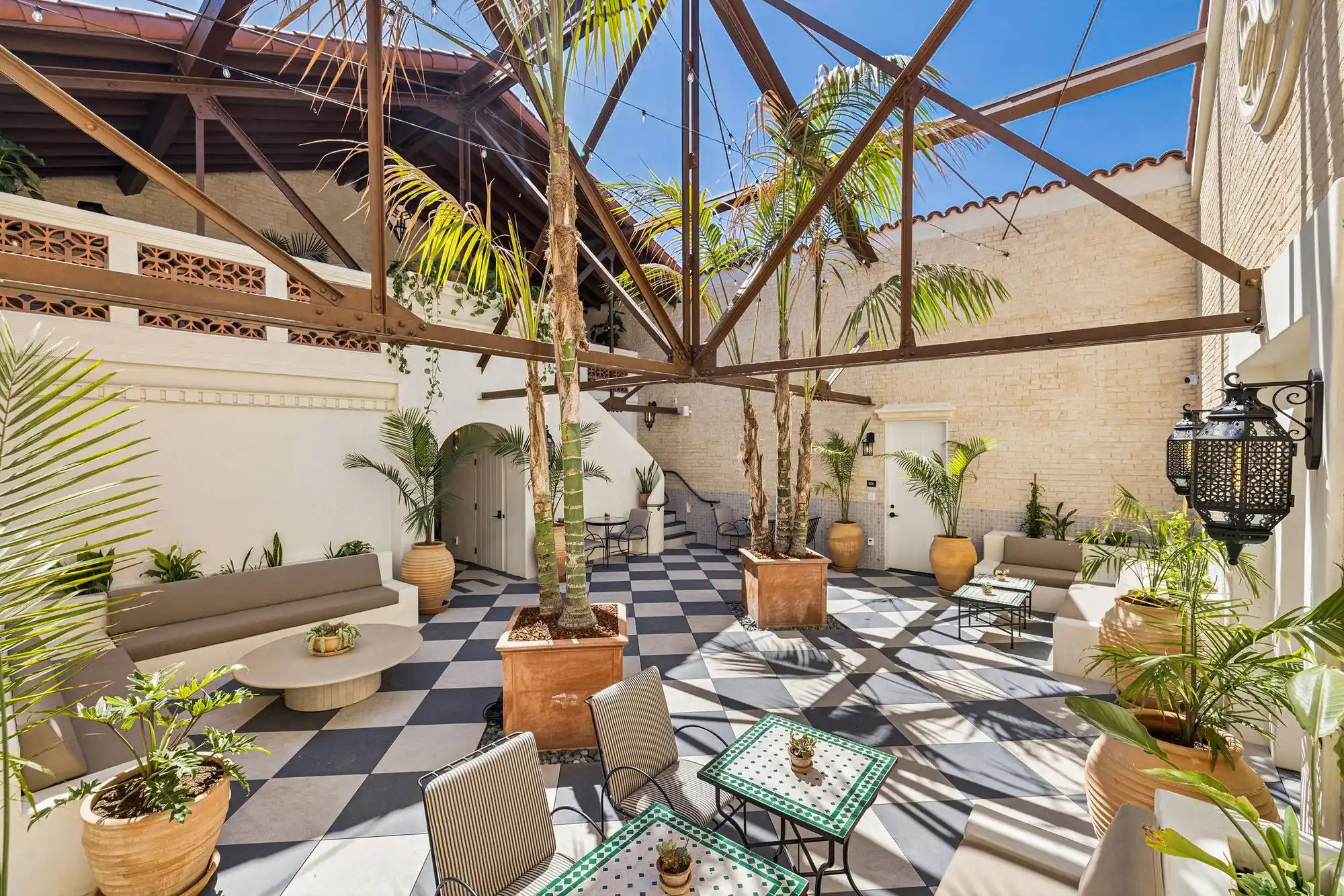
Casa Iglesia was a church, built in 1924 on Chapala Street. The sanctuary is still the sanctuary. In the photograph above, the courtyard beside it is open to the sky: the roof was cut away and the original steel left exposed, palms were planted straight up through it, and the floor was laid in checkerboard tile. Guest room doors open onto it. That is the first room of the hotel you walk into, and nobody works there.
Every one of our buildings has some version of that room. It exists because the square footage was not spent on a counter.
The rest of it
Two other things guests tell us they notice. Every room has a kitchenette, which matters more than it sounds like it should on the third morning of a trip, when you would rather make coffee than get dressed to find some. And no two rooms look the same, because these are old buildings and we restored them rather than gutting them into a hallway of identical boxes.
The locations are walkable on purpose. Close to the restaurants, close to the shops, close to the reason you came. You are not going to need the desk to call you a car to somewhere you could have walked.
The test we hold ourselves to is simple enough. Nothing we removed should be something you end up wishing were there.